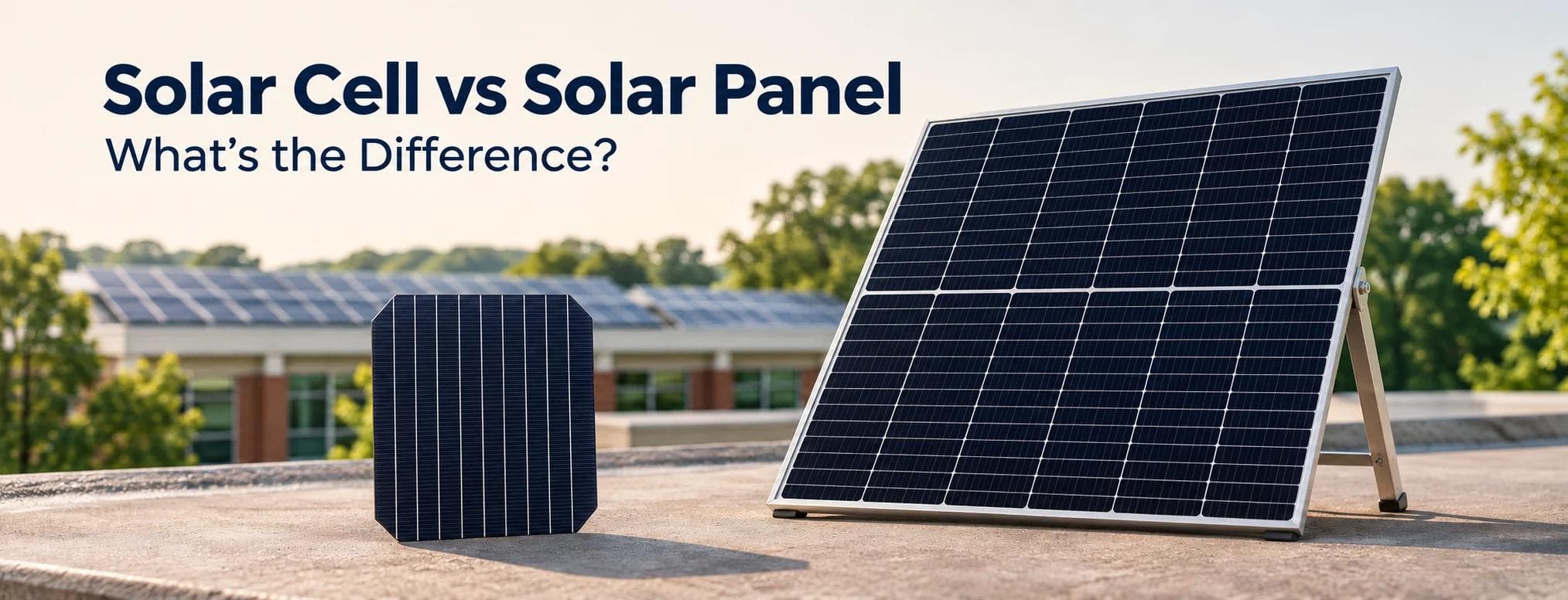
A solar cell converts sunlight into electricity. A solar panel contains multiple solar cells connected together and protected within one unit.
Understanding that relationship also explains why participating in solar does not always have to begin with buying a whole panel.
What is a solar cell?
A solar cell is usually made from silicon, a semiconductor material. When sunlight reaches the cell, it transfers energy to electrons, creating an electrical current through the photovoltaic effect.
On many rooftop panels, you can see individual cells arranged across the surface. Each contributes to the panel’s electrical output.
For a deeper explanation of the science, read What Is a Solar Cell? How Silicon Solar Cells Turn Sunlight into Energy.
What is a solar panel?
A solar panel, also called a photovoltaic module, contains connected solar cells enclosed within protective layers. Glass, encapsulation materials and other components protect the cells and help the assembly withstand outdoor conditions.
Multiple panels can then form part of a larger installation supplying electricity to a home, school, hospital or business. This relationship between cells and modules is explained by the U.S. Department of Energy.
| Feature | Solar cell | Solar panel |
|---|---|---|
| What it is | An individual photovoltaic device | An assembly of connected solar cells |
| Main role | Converts sunlight into electricity | Connects and protects cells, combining their output |
| Electrical output | A relatively small contribution | The combined contribution of many cells |
| Where it belongs | Inside a panel | Within a solar installation |
Solar cells make up panels. Panels work together within an installation.
How many solar cells are in a solar panel?
There is no single number that applies to every panel. The count depends on its design, dimensions and cell technology.
Common configurations include 60 or 72 full cells. Half-cut designs divide cells into smaller sections, so you may see specifications listing 120 or 144 half-cells instead. Other layouts are also available.
A panel containing 120 half-cells does not automatically produce twice as much power as one containing 60 full cells. The cell dimensions, efficiency and overall design matter too. Manufacturer Tigo explains these differences in its PV module overview.
Can one solar cell work on its own?
Yes. An individual solar cell can generate electricity when exposed to light and connected to a suitable circuit.
However, generating electricity is different from producing enough usable power for an appliance. A single cell has a low voltage and limited output. Connecting cells together allows a panel to provide more useful electrical output.
A complete installation also needs appropriate wiring and supporting equipment. For many buildings, that includes an inverter to convert the panels’ direct current into alternating current.
Does a solar panel always produce the same amount of power?
No. Actual output changes with sunlight, shading, temperature, orientation and other operating conditions.
The wattage shown on a panel’s specification sheet is measured under standard test conditions. It is not a promise that the panel will produce that amount throughout the day.
Location also affects how much electricity an installation can generate over a year. Our article on why geography matters in global solar energy explores why the same equipment can perform differently in different places.
Why Sunbucks offers individual cells instead of whole panels
An individual solar cell costs less than a whole panel, making it easier to start with a budget that suits you.
With Sunbucks, you can purchase an identified solar cell from €2 and lease it back to Sunbucks under the selected project’s agreement. The cell stays within the operating installation, and Sunbucks pays the agreed equipment-rental fee for using it.
Sunbucks funds and establishes the installation before offering its cells to customers. The project is already operating and generating electricity; your purchase is not being used to construct that particular installation. Read more in Why Sunbucks Is Not Crowdfunding.
You do not need your own roof, an installer or the budget for a complete solar system. Our guide to how solar cell rental works explains the arrangement.
Start with one cell. Build at your own pace.
Start with one available cell from €2, with no minimum purchase beyond that single cell. There is no requirement to buy a whole panel or a larger bundle. Add more whenever your budget allows, subject to availability.
If you are working towards reducing your own or your family’s carbon footprint, owning cells offers a manageable way to participate in clean-energy generation alongside everyday efforts to reduce emissions.
Track your cells’ estimated environmental impact using project data. It depends on the electricity generated and the electricity it replaces; purchasing cells does not automatically cancel out household emissions.
While your cells are leased to Sunbucks, you receive rental fees according to their project agreements. The price, remaining term and payment schedule are shown before purchase, and withdrawals are subject to the applicable conditions, including the initial 100-day hold. See how Sunbucks solar cell rental fees are calculated for the details.
See what happens after you buy your first Sunbucks solar cell.