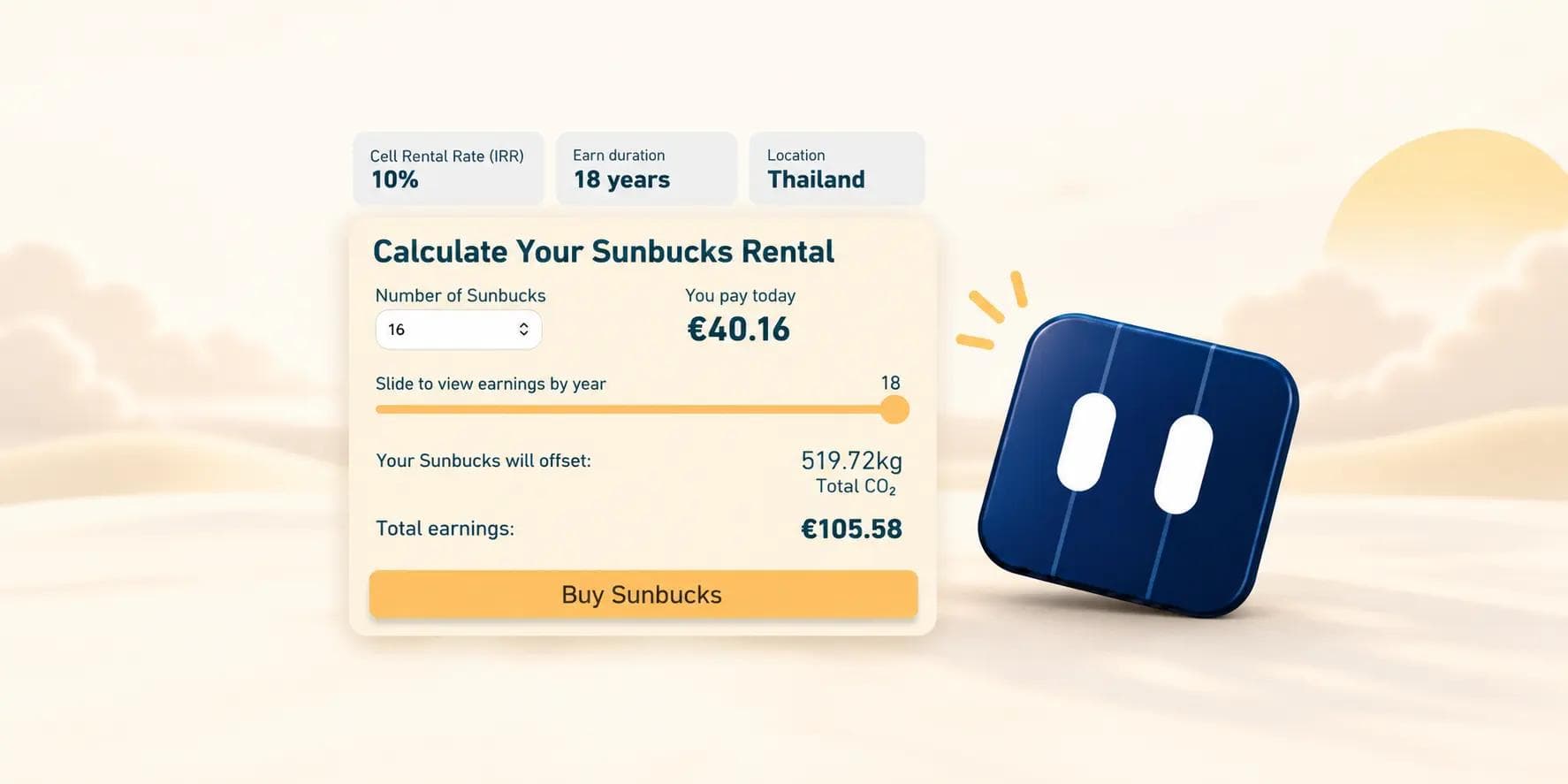
When you buy a solar cell through Sunbucks and lease it back to us, the money you receive is an equipment-rental fee. It is payment for Sunbucks’ use of your identified physical solar cell within a working solar installation. For a broader explanation of the model, see How Does Solar Cell Rental Work?
But where does that rental fee actually come from, how is it calculated, and why can a newly purchased cell sometimes show an immediate balance in your Sunbucks dashboard?
The answer starts with an important difference between Sunbucks and crowdfunding.
Sunbucks Does Not Use Customers to Fund the Solar Installation
Sunbucks is not crowdfunding the construction of solar projects.
We finance, develop and arrange the installation first. The solar installation is completed, commissioned and operating before selected solar cells connected to that project are made available for purchase through Sunbucks.
That means when you purchase a Sunbucks solar cell, you are not contributing money toward a future project that still needs to be built.
You are purchasing an identified physical solar cell connected to an established solar installation that is already operating.
The installation exists independently of your purchase. Sunbucks has already funded the project and established the commercial arrangements with the host organisation and our international service partners. Only after a project has been operating do selected cells become available through the Sunbucks platform.
The customer can then purchase an identified cell and choose to lease it back to Sunbucks under the project’s fixed-term equipment-rental arrangement. For more detail on why this is different from crowdfunding, see Is Sunbucks.com Legitimate?
Every Solar Project Has Its Own Start and End Date
Each Sunbucks project has a fixed Site Start Date and Site End Date.
Those dates belong to the project — not to the individual customer.
This means that buying a cell later does not restart the rental period.
For example, if a solar installation began its rental period on 1 January 2023 and finishes on 31 December 2040, those dates remain the same whether you purchase your cell in 2023, 2026 or later.
The cell joins the existing rental arrangement for that site and remains linked to the original project timetable.
This is also why purchasing later can create something unusual: your dashboard may show rental fees almost immediately.
Why Can My Dashboard Show Earnings Immediately After I Buy?
Some Sunbucks projects have already been operating for several years by the time cells are made available on the platform.
Where the relevant Project Information includes accrued rental fees, the rental schedule can include the amount that has accrued from the project’s original Site Start Date up to the date that you purchase the cell.
Sunbucks refers to this as an Accrued Rental Fee.
You are not being paid interest for a period before you owned the cell, and you are not being given ownership retrospectively.
Instead, it is a contractual adjustment within the cell’s fixed rental schedule. The project has already been operating from its original start date, so the rental calculation can include the rental amount associated with that earlier operating period when the cell is sold later.
That amount can therefore appear in your dashboard as soon as your purchase has been completed. The post-purchase process is explained step by step in What Happens After I Buy a Sunbucks Solar Cell?
Example: Project 03012 – High School
A good example is 03012 – High School.
The rental period for this installation began on 1 January 2023.
If you purchase solar cells connected to Project 03012 after that date, the applicable rental calculation can include the accrued rental fees from the project’s Site Start Date up to your purchase date, as shown on the Sunbucks platform before you buy.
This means a customer buying cells today may open their dashboard after purchasing and already see a rental balance.
The reason is simple: the solar installation itself did not just start operating. It has already been working and generating electricity for the host site.
The rental schedule is connected to that established project timeline.
Why Can’t I Withdraw That Balance Immediately?
Even when accrued rental fees appear in your dashboard immediately after purchase, they are subject to the 100-day Withdrawal Hold.
The 100-day period starts when Sunbucks sends your purchase confirmation.
During those 100 days, equipment-rental fees can continue to accumulate and can be displayed in your Dashboard or Wallet, but they remain pending and cannot yet be withdrawn.
After the 100-day hold has expired, eligible rental fees marked as available can be withdrawn in accordance with the Sunbucks withdrawal rules, identity checks, payment-processing requirements and applicable Terms and Conditions.
So there is an important difference between rental fees being shown in your dashboard and rental fees being available to withdraw.
Your dashboard can therefore show a balance from the beginning while the withdrawal date is still 100 days after your purchase.
Why Do Sunbucks Rental Payments Increase Each Year?
Sunbucks rental payments are not necessarily the same every year.
The rental schedule is designed so that the contractual equipment-rental amount increases over the life of the project.
The applicable yearly schedule is shown through the Sunbucks Cell Rental Calculator before purchase.
This allows a customer to see how the rental payments are expected to develop over the remaining project term rather than looking only at the first year’s payment.
The important point is that this schedule is agreed as part of the cell’s rental arrangement.
It is not recalculated every year according to bank interest rates, stock-market movements or central-bank policy.
What Does the 10% IRR Shown on the Sunbucks Calculator Mean?
For current Sunbucks projects, the Cell Rental Calculator can express the complete rental-fee schedule as an equivalent 10% IRR over the full project period.
IRR stands for Internal Rate of Return.
In this context, IRR is simply a mathematical way of summarising a series of scheduled payments over time as one comparable percentage.
It does not mean that Sunbucks is paying 10% bank interest on your account balance.
It does not mean you have deposited money with Sunbucks.
And it does not turn the solar cell into a share, bond, security or investment product.
You own an identified physical solar cell, and Sunbucks pays an equipment-rental fee for using that cell under the lease-back arrangement. For a detailed comparison, read Solar Cell Rental vs Solar Investing.
The IRR figure is therefore a way of describing the overall economics of the rental schedule across the complete project term.
Withdrawing Your Rental Fees Does Not Reduce Future Rental Payments
This is another major difference between Sunbucks rental payments and interest earned on a savings account.
Imagine you had €1,000 in a normal bank account earning interest.
If you withdrew €500, there would only be €500 left generating future interest. Your future interest would therefore normally decrease.
Sunbucks does not work that way.
Your future equipment-rental fee is based on the solar cell and its agreed rental schedule, not on how much money you leave sitting in your Sunbucks Wallet.
If you withdraw rental fees that have already become available, you still own the same number of solar cells and those cells remain subject to the same rental schedule.
Withdrawing €100 of previously earned rental fees does not reduce the rental value of your cells.
The next scheduled rental payment is calculated according to the agreement for those cells — not according to your remaining Wallet balance.
There is therefore no requirement to leave rental fees in your Sunbucks account in order to maintain the agreed rental schedule. The same point is also covered in the Sunbucks FAQ.
Rental Fees Are Not Linked to Interest Rates
Sunbucks equipment-rental fees are based on the contractual arrangements for the solar equipment.
They are not designed to move up and down with European Central Bank rates, savings-account rates, mortgage rates or financial markets.
The commercial rental schedule is established for the project in advance through fixed contractual arrangements between Sunbucks and its international service partners, together with the relevant project and insurance arrangements.
This provides a predetermined rental schedule for the solar equipment rather than a floating financial interest rate.
As with any commercial agreement, payments remain subject to the relevant Project Information, Lease-Back Agreement, Sunbucks Terms, compliance requirements and other applicable contractual conditions.
What Happens After the Rental Term Ends?
Every project has a fixed Site End Date.
The rental period does not extend simply because somebody purchased their solar cell later.
Once the Site End Date is reached, equipment-rental fees for that project stop.
Under the relevant project terms, ownership of the cell then transfers to the host school or other approved recipient.
The solar equipment can therefore continue producing renewable electricity for the community even after the Sunbucks rental period has ended.
For a complete explanation of the end-of-term process, read What Happens When a Solar Cell Rental Term Ends?.
The Simple Version
Sunbucks first finances and establishes a real solar installation.
The project begins operating.
Only later are selected identified solar cells from that operating installation made available for purchase through Sunbucks.
When you purchase a cell and lease it back, you receive contractual equipment-rental fees according to that project’s predetermined schedule.
If the project began operating before you purchased your cell, the project may include an accrued rental fee from the original Site Start Date. That is why your dashboard can sometimes show a balance immediately after purchase.
Those rental fees remain subject to the 100-day Withdrawal Hold.
The yearly rental schedule can increase over time and is shown through the Sunbucks Cell Rental Calculator. For current projects, the complete payment schedule is expressed as an equivalent 10% IRR over the project term.
That IRR is a calculation used to describe the rental schedule. It is not bank interest, a dividend or a financial investment return.
And importantly, withdrawing rental fees that you have already earned does not reduce the future rental payments agreed for your solar cells.
Your rental income is linked to the use of your identified solar cells, not to the balance sitting in your Sunbucks Wallet.
Want to See the Numbers for Yourself?
Visit an available Sunbucks project and use the Cell Rental Calculator to choose the number of solar cells and see the applicable project term, scheduled equipment-rental fees and overall rental calculation before purchasing.
Important: Project terms can differ. Always review the specific Project Information and the Sunbucks Terms and Conditions before purchasing a solar cell. Equipment-rental fees are contractual payments for the use of identified solar equipment and are not interest, dividends, profit shares, securities or guaranteed investment returns.