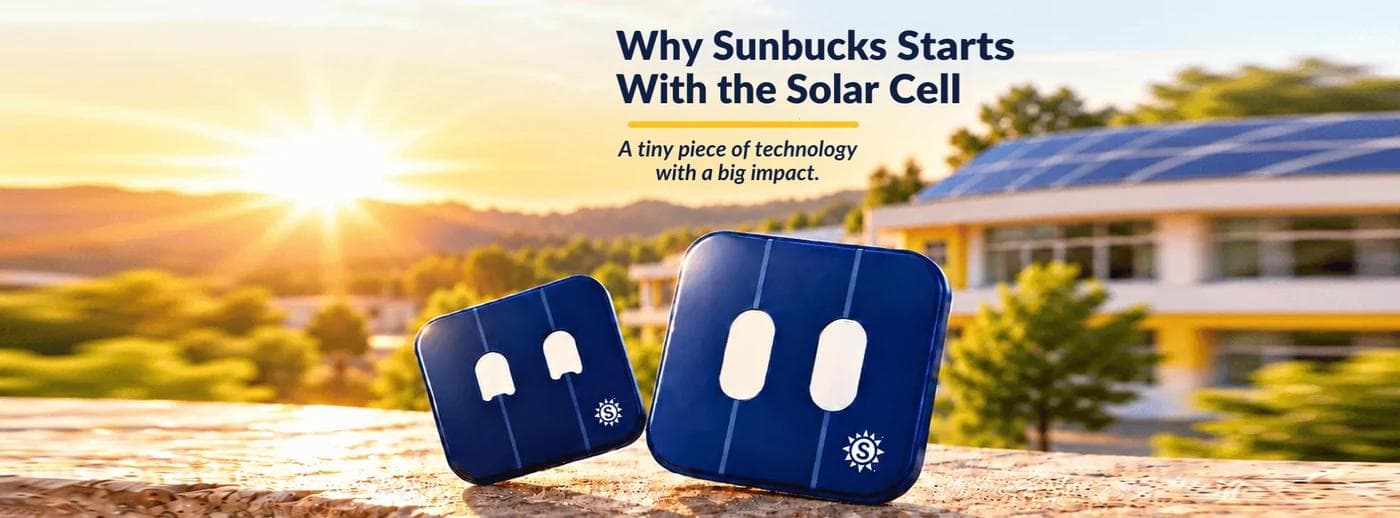
When most people look at a solar project, they see the panels first. But the panel is really a home for something much smaller: the solar cell. Those little blue or black cells are the part that actually turns sunlight into electricity. Without them, no solar power is being generated. That is why Sunbucks starts with the cell.
The tiny part that does the real work
A solar cell is the smallest working electricity-producing unit inside a solar panel. A panel brings many cells together, protects them and connects them, but the cell is where sunlight actually becomes electrical energy. In that sense, it is the most valuable part of the panel for what it actually does.
If you want the science in more detail, we explain it in What Is a Solar Cell? How Silicon Solar Cells Turn Sunlight into Energy. The simple version is that sunlight reaches the cell and the cell turns part of that light energy into an electrical current.
It still feels a little like magic
The process is called the photovoltaic effect, and even when you understand the science, it is still pretty amazing. There is no fuel being burned, no engine running and no moving parts inside the cell. Light simply reaches the material and electricity starts to flow.
Sunlight arrives as tiny packets of energy called photons. When those photons hit the semiconductor material inside the cell, they can give electrons enough energy to move. The clever design of the cell creates an internal electric field that guides those electrons in one direction. That movement becomes electrical current. Sunlight in, electricity out.
For the science behind it, the U.S. Department of Energy explains how photovoltaic cells work and why silicon makes such a useful semiconductor.
It is such a simple-looking object, but the physics and engineering behind it are extraordinary. A cell can sit quietly in the sun for years, doing the same job again and again with no combustion, no smoke and no mechanical movement.
And at the heart of it is silicon
Most solar cells used today are built around silicon. Silicon is one of the most abundant elements on Earth and the second-most abundant element in the Earth's crust after oxygen. That is one of the reasons it is such a brilliant material for solar technology.
A modern solar cell is not literally just a piece of silicon. It is built around a very pure silicon wafer with carefully designed layers and fine metal contacts. But silicon is the heart of the cell. It behaves as a semiconductor, which means engineers can control how electricity moves through it. That is what makes the photovoltaic effect useful instead of just interesting science.
We think there is something beautiful about that design. One of the most common materials in the Earth's crust, shaped with incredible precision, can turn one of the most freely available resources we have - sunlight - directly into electricity.
So why did Sunbucks choose the solar cell?
Because we wanted clean energy to feel real and accessible. Instead of starting with an entire solar panel or a whole solar project, we go right down to the smallest part that actually produces the power: one individual solar cell.
With Sunbucks, customers can buy identified physical solar cells connected to real solar installations. That lets someone start very small, from as little as EUR 2, without needing a roof, an installer or their own solar system. The cell is not a token or a symbolic share of a future idea. It is physical solar equipment associated with a real project.
The solar project comes first
This part is important. Sunbucks funds and builds the solar installation first. The project is installed, operating and generating electricity before cells are offered through Sunbucks. Customers are not being asked to finance the construction of that particular project. We explain that distinction in Why Sunbucks Is Not Crowdfunding.
Once the project is working, individual cells can be made available through Sunbucks. That means what you are connecting yourself to is already part of a real clean-energy system doing a real job.
How the Sunbucks Solar Cell Rental Model Works
After buying an eligible solar cell, you can choose to lease it back under the Sunbucks fixed-term rental model. Sunbucks manages the equipment as part of the larger solar installation, and under the rental agreement you receive the agreed rental payment for the use of your cell. You can read the step-by-step explanation in How Does Solar Cell Rental Work?.
Here is a simple example. Imagine a school solar project that is already built and generating electricity. You buy one identified solar cell in that project for €2. If the cell is eligible for rental, you can choose to lease it back to Sunbucks under the project’s fixed-term agreement. The cell remains part of the working installation, while Sunbucks pays you the rental fee agreed in the contract. This is an example of how the model works, not a promise of a particular payment amount.
Legally, that payment is an equipment rental fee. But there is another way we like to think about it too: it is our way of saying thank you for doing your part in a cleaner world. You chose to own a small piece of clean-energy technology, and while that equipment is being used in the project, Sunbucks pays the agreed rental fee for using it.
Does buying a cell really help clean energy?
Yes, but we want to be clear about how. Your purchase does not build that particular installation—Sunbucks has already funded it upfront. By buying a real cell in an operating project, you support the Sunbucks equipment-rental model and its ability to involve more people in clean energy. As Sunbucks develops further projects, that broader participation can help the business grow, although buying one cell does not directly fund a new installation.
It also makes solar personal. Instead of clean energy being something happening somewhere else, you can point to a specific cell and say: that is mine, it is part of a real solar project, and it is helping generate electricity from sunlight.
One small cell, part of something much bigger
One solar cell is tiny. On its own, it will not power a school or a hospital. But thousands of cells working together can. That is the idea we love: something very small can be part of something genuinely important.
Cell by cell, panels are built. Panel by panel, solar installations are built. And project by project, more electricity can be generated without burning fossil fuels.
That is why Sunbucks starts with the solar cell. It is small, understandable and real. It is where the photovoltaic effect actually happens, where silicon and sunlight meet, and where clean electricity begins.
If you are thinking about getting your first cell, the next useful read is What Happens After I Buy a Sunbucks Solar Cell?. It explains exactly what happens after purchase and how the cell fits into the wider Sunbucks model.